Imagining the Adaptive Organization
A radical experiment in the 1970's helps us imagine how AI will change the shape of organizations
In our article introducing the AI Dividend we suggested that organizations must fundamentally transform their architecture to embrace the continuous learning and evolution necessary to keep up with the speed of change in an AI driven world. We called this the Adaptive Organization. In this article, we begin to explore the possibilities of how the Adaptive Organization might take shape by looking to the past.
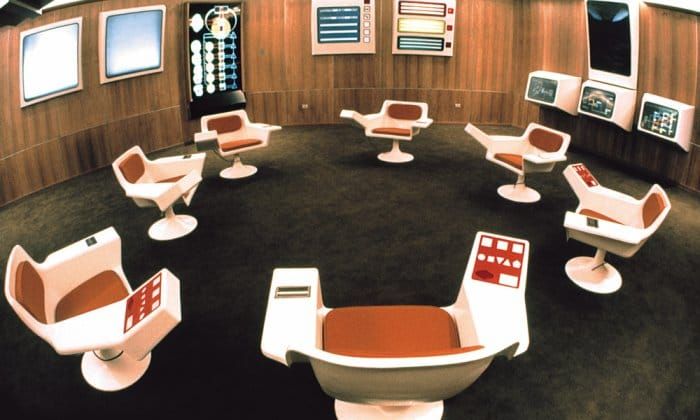
In October of 1972, Chile was stuck. Tens of thousands of truck drivers had gone on strike, and in a country that is essentially one long road, the entire economy had stopped with them. What broke the gridlock was not force or political maneuvering, it was the continuous flow of information. In a Santiago office, a small team watched real-time reports stream in from across the country over a patchwork network of telex machines, then used what they learned to route the two hundred or so trucks still loyal to the government around the blockades. The network belonged to Project Cybersyn, an audacious experiment to wire up the Chilean economy like a living nervous system. It was an effort way ahead of its time, an audacious attempt to implement the Viable System Model (VSM) championed by Stafford Beer, a pioneer in organizational theory. Beer had worked out what any organization needs, functionally, to stay alive in a turbulent world: the ability to sense, to coordinate, to adapt, and to know what it is for in the first place. The Chilean trucking strike was the VSM's first real stress test, and the nervous system passed. Fifty years on, as AI begins to change the shape of every organization, Beer's model of what is essential for a functioning system is a helpful guide as we imagine the Adaptive Organization.
The VSM was born from Cybernetics, a field of study that attempts to understand and manage complex systems. It gets quite wonky, and truthfully, we only have a superficial understanding of any of it. You can check out an AI generated research report, which shares details of the model and its application since Project CyberSyn.
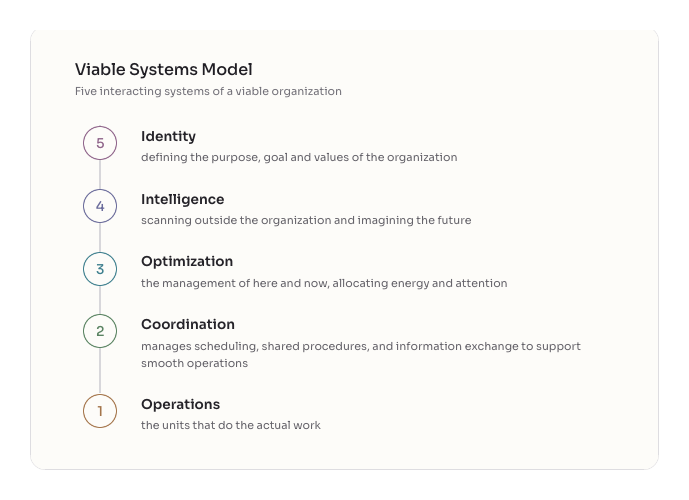
A few things did stand out that make VSM feel particularly applicable to the present moment though. The model emphasizes real-time information flows, which allow for adaption at each layer of the system. Beer famously argued against "driving the organization by looking in the rearview mirror". This feels particularly relevant as those information flows are dramatically improved today compared to the primitive telex machines of Project CyberSyn. The VSM model views the organizational structure as a giant filter for complexity, taking in enormous amounts of information, compressing it though people, process, and technology to make it accessible for leaders to make decisions. Beer argued that the fundamental flaw of organizations was an inability to process the sheer volume of data coming at them. AI promises to change this by not only making those information flows more accessible, but also to process them in real-time and take autonomous action. What resonated most though, is the functional description of the five systems which allows us to speculate as to where AI and humans will fit in the Adaptive Organization. The five systems provide a map for what makes a working, minimal system. AI looks to be uniquely capable of managing the complexity of coordination (System 2) and optimization (System 3) across an organization. This frees up human focus at Systems 4 and 5, setting purpose and imaging the future.
We are seeing some early patterns and possible principles from our early thinking about an AI enabled VSM-based organization. They will no doubt evolve as we dig further.
Functions persist, layers don't
Every viable org still needs all five systems: operations, coordination, optimization, intelligence, identity. AI should excel at the middle layers (coordination + optimization). This will dramatically flatten org charts and allow human effort to focus at the higher order systems (Identity and Intelligence).
Coordination becomes ambient
Haier shows the S3 layer doesn't get automated so much as substituted: internal price signals, automatic target triggers, and shared platforms do the allocating. The AI-native version is agents negotiating service agreements with each other. The center's residual job is designing the rules of the internal market, not making the calls.
Manage by exception
Beer's algedonic principle: autonomy at every level, escalation only when a unit can't self-correct in time becomes fully practical for the first time. AI integrated organizations will have continuous sensing with attention routed only to anomalies. The quarterly review cycle will be replaced by an always on nervous system.
Minimum viable organization shrinks
AI gives small frontline teams the capabilities that once required an entire enterprise, so the Adaptive Organization will scale by fractal units. Teams will behave like cells, autonomous and connected at the same time. Humans at the edge carry real judgment and real accountability
You can’t automate purpose and vision
Identity, purpose, ethical boundaries, and “where are we going” can't be delegated. These are the optimizing functions for the whole system. This is where human judgement and agency thrives.